Puzzle, Book or Small Making Project: Picking an Evening Pastime
Choose an evening pastime by its setup, attention and stopping point, so a puzzle, book or small making project fits the energy you have tonight.
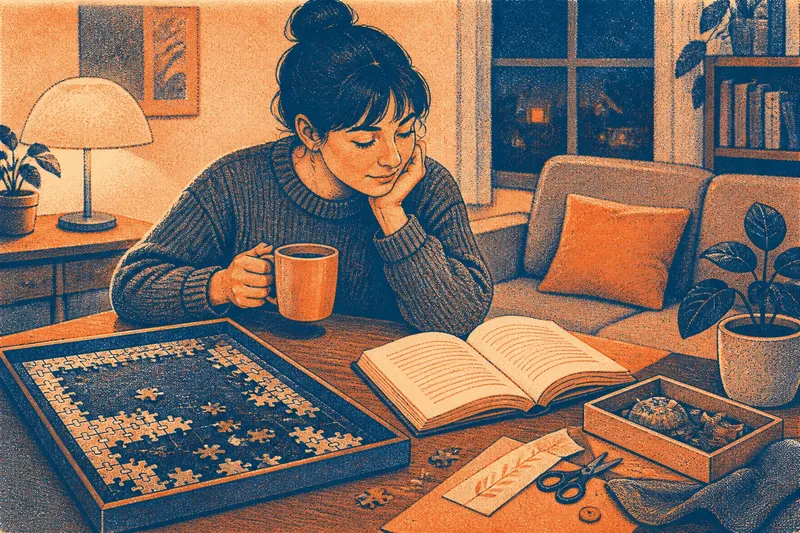
Which evening pastime fits the kind of attention you have left? Choosing a puzzle, book or small making project is less about finding the best hobby than matching the activity to the room, your energy and the moment you want to stop. A few practical distinctions can make the choice feel easy rather than like another decision to manage.
Let the evening set the scale
Start with the conditions already in front of you. Is the table clear, is the light comfortable, and do you have enough quiet to follow a thought? These ordinary details often matter more than whether you feel vaguely “creative” or “in the mood to read.”
A book usually asks for little setup: a lamp, a place to sit and something you want to read. A puzzle needs a surface that can stay occupied, plus enough light to distinguish pieces. A small making project may need tools and materials gathered before the first satisfying bit can happen.
That difference makes the book a natural choice when the room is untidy or the evening is already crowded. The puzzle works well when you can leave a board undisturbed. Making suits a night when laying out a few materials feels pleasant rather than like a chore.
Think about the likely interruption, too. A book slips into a bag or onto a shelf. A puzzle can be covered with a board or cloth if the table must be used. A project with wet paint, uncured glue or loose parts may be harder to pause neatly, so choose a simpler version when the evening could be broken up.
Notice how each pastime holds attention
Reading concentrates attention on a sequence someone else has arranged. You follow a voice, an argument or a plot, and the next page offers a clear invitation. This can feel restful when you want to be carried along, though a dense book may ask for more focus than a tired mind can comfortably give.
A puzzle spreads attention across a field. You can scan, sort, try a piece, then look away without losing the whole thread. Some people find that gentle searching settles the mind; others experience a busy tabletop as one more thing demanding a solution. The useful question is whether you want to follow a line or wander among small possibilities.
Making involves decisions as well as attention: which paper, which color, which stitch, which next mark? A modest project can offer a welcome sense of agency, especially if the materials are familiar. But a new technique can turn a quiet evening into repeated pauses to consult instructions or correct a frustrating result.
Choose a project whose first action is obvious. Folding a paper bookmark, mending a loose button or sketching a familiar mug has a low barrier to entry. A complicated kit with many parts may be enjoyable on another night, but it is not necessarily the best companion for an hour of uncertain energy.
Choose a stopping point before you begin
The three pastimes differ in how naturally they let you stop. A chapter or a section gives reading a built-in pause, though a gripping story can make “one more page” tempting. A puzzle offers no final boundary until the last piece is placed, so decide on a small stopping cue such as finishing one corner or sorting a handful of edge pieces.
A making project can have the clearest endpoint if you define it narrowly: mend one button, cut the pieces for a card, or sketch one object. Leave the larger ambition for another evening. A task with an observable finish makes it easier to enjoy the process without feeling obliged to keep going until the whole idea is complete.
Say you have a clear kitchen table, a little energy and an hour before bed. You might spread a small jigsaw on a tray and decide to work only until you complete the border or the timer you set rings. The expected observable result is a contained patch of progress and a tray that can be moved aside, rather than an unfinished puzzle taking over the evening.
For any pastime, make the restart simple. Put a bookmark where you stopped, keep puzzle pieces grouped on a tray, or place a project’s tools together in a shallow box. A tidy stopping ritual is more useful than trying to finish while your attention has already gone.
Match the choice to tonight’s constraints
- If you want a quiet, portable activity: choose a book, especially one you can read in short stretches without needing to remember a complicated thread.
- If your hands want something to do: choose a puzzle or a familiar making task, depending on whether you prefer searching or making decisions.
- If the shared table must stay clear: choose a book or a compact project that fits in a box; avoid spreading a large puzzle across a surface you need tomorrow.
- If interruptions are likely: choose an activity that can be paused without a delicate setup, such as reading or a simple sketch.
- If you want a visible sense of completion: choose a small repair or a defined craft task, rather than a project with an open-ended finish.
These are not rules about what counts as a worthwhile evening. They are ways to avoid selecting an activity whose demands clash with the space, attention or time you actually have.
Small decisions can make the choice easier
Is a puzzle better than a book before bed?
Neither is inherently better; the fit depends on what helps you settle. A familiar, undemanding book may be easier to put down, while a puzzle can suit you if quiet handwork feels calming and the surface is easy to clear.
What kind of small making project suits a short evening?
Pick something with familiar materials and one visible endpoint, such as mending a button or making a simple paper bookmark. If the task requires a long setup or new instructions, save it for a night when you have more patience for decisions.
How can I keep a puzzle from taking over the table?
Work on a sturdy tray or a portable puzzle board if the puzzle’s size permits, and decide where the pieces will go before you start. A cloth can keep pieces together during a pause, but do not rely on a cover that will be awkward to move or store.
What if I keep switching between activities?
Make one small commitment rather than demanding a whole evening from yourself: read a section, sort a few pieces or finish one repair. If you still want to switch after that, you have learned something about the attention you wanted tonight.
Skip the elaborate preparation
It is rarely worth buying a new set of supplies, rearranging the room or designing a perfect routine just to make an ordinary evening activity feel legitimate. Use what is already nearby: a library book, a puzzle you own, scrap paper, a needle and thread. If a missing material genuinely prevents you from starting, note it for later rather than turning tonight into an errand.
Keep the choice modest. A pleasant evening can consist of a few pages, a handful of pieces or one small thing repaired. The best evening pastime is often the one that lets you begin without ceremony and stop without leaving the room in a state you resent.
When you next choose a puzzle, book or small making project, ask what you want your attention to do and where you want the activity to end. That answer can guide the evening more reliably than a plan to make every free hour count.